
Introduction
In a world driven by innovation, not all valuable assets are visible. Trade secrets — confidential business information, formulas, strategies, and processes — often form the backbone of a company’s competitive advantage. Unlike patents or trademarks, which are publicly disclosed, trade secrets rely on secrecy and strategic protection. For companies in Guatemala and across Latin America, understanding how to protect these intangible assets is crucial to maintain competitiveness and safeguard long-term value.
What is a Trade Secret under Guatemalan Law
Under Guatemala’s Industrial Property Law (Decree 57-2000) and its implementing regulations, “undisclosed information” (secretos empresariales / industriales) may be protected as a trade secret — provided it: (i) is not generally known or readily accessible to persons usually dealing with that kind of information, (ii) has economic value because it is secret, and (iii) is subject to reasonable security measures.
The law explicitly contemplates trade secrets that refer to:
Because a trade secret does not require registration, protection begins the moment the information qualifies — but maintaining protection demands consistent and strategic actions.
Why Trade Secrets Matter More than Ever
But trade secret protection without strategy is risky: misappropriation, employee turnover, or failure to enforce confidentiality can destroy decades of value.
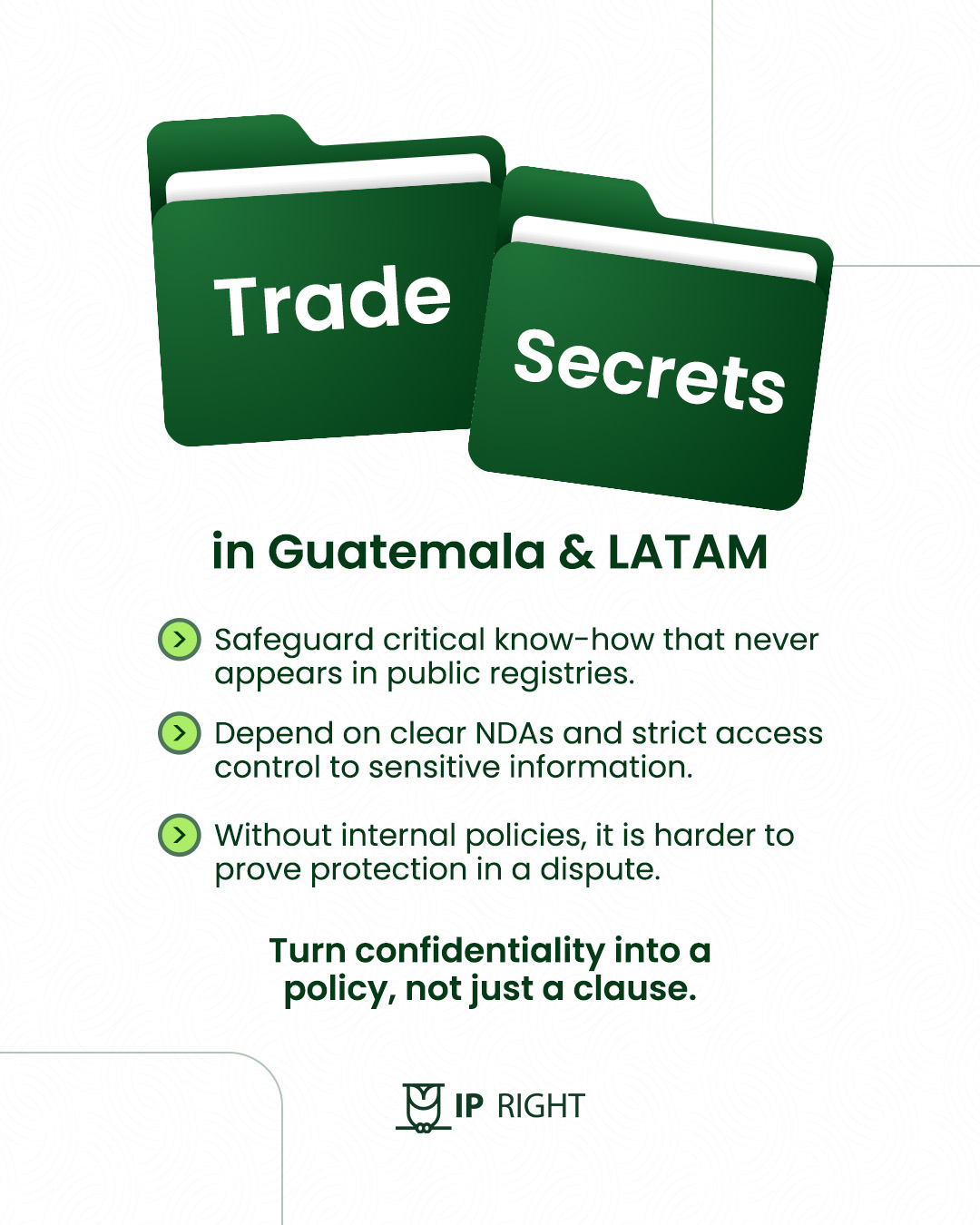
Best Practices for Protecting Trade Secrets
Challenges & Enforcement in Guatemala
Although trade secrets are regulated under the Industrial Property Law, Guatemala does not have a specialized agency dedicated solely to their enforcement. Instead, misappropriation cases often rely on general civil litigation — which can be slow and costly.
Therefore, it is essential that businesses adopt a preventative, internal-first approach rather than waiting for enforcement after a breach occurs.
Conclusion
Trade secrets are among the most strategic and valuable forms of intellectual property — especially for companies whose competitive advantage lies not in patented inventions, but in proprietary know-how. Protecting them requires a holistic approach: legal agreements, internal policies, security measures, and ongoing vigilance.
At IP Right, we help businesses in Guatemala and Latin America identify, protect, and enforce their trade secrets — designing tailored confidentiality frameworks, conducting internal audits, and advising on risk mitigation so that valuable knowledge remains secure.
